
About
Hi! I am a postdoc in the binary-stars group at the Galaxies and Cosmology department of the Max-Planck-Institute for Astronomy in Heidelberg, and specialize in statistical modeling of extreme astrophysical phenomena related to the death of massive stars:
- core-collapse supernova explosions,
- the birth of neutron stars and stellar-mass black holes.
During the PhD, I have been a member of the Physics of Stellar Objects group at the Heidelberg Institute for Theoretical Studies and a fellow of the International Max Planck Research School for Astronomy and Cosmic Physics. Prior to this, I completed a Master of Science in Physics at the University of Münster, a Master of Studies in Philosophy of Physics at the University of Oxford and gained some technical experience as a data scientist & deep-learning engineer.
Press releases:
- Support from gravitational wave observations of binary black hole (BH) mergers for a bimodal BH mass distribution as predicted by our model of BH formation from massive star evolution,
- Massive star evolution, their final fates and gravitational waves modeled using machine-learning in the three papers related to my PhD thesis,
- Deep-learning modeling of stellar evolution at high accuracy during >99.9% of stellar lifetimes.
Apart from stars and black holes, I like exploring different kinds of water sports, experimenting with algorithmic computer art and vegetarian culinary. Take care!



kmaltsev@mpia.de
Publications
- Unveiling the Milky Way with a Gaia DR3 census of OB-type stars within 2 kpc. I: Tracing local Galactic structure, massive star-forming regions and
core-collapse supernova progenitors,
A. L. Quintana, K. Maltsev, E. Poggio, E. L. Hunt, N. J. Wright, S. R. Berlanas, L. Casamiquela, A. de Burgos, A. Parul, M. Haywood, P. Di Matteo, C. Laporte and J. Martínez García, submitted to MNRAS, arXiv:2607.07068 - Explodability criteria for the neutrino-driven supernova mechanism,
K. Maltsev, F. R. N. Schneider, I. Mandel, B. Müller, A. Heger, F. K. Röpke and E. Laplace,
2025, A&A 700, A20, doi:10.1051/0004-6361/202554931 - Gravitational-wave model for neutron star merger remnants with supervised learning,
T. Soultanis, K. Maltsev, A. Bauswein, K. Chatziioannou, F. K. Röpke and N. Stergioulas,
2025, Phys. Rev. D 111, 023002, doi:10.1103/PhysRevD.111.023002 - Statistical modeling of the progenitor evolution and formation of neutron stars and stellar-mass black holes, K. Maltsev, 2024, PhD thesis, University of Heidelberg, doi:10.11588/heidok.00036020
- Scalable stellar evolution forecasting,
K. Maltsev, F. R. N. Schneider, F. K. Röpke, A. I. Jordan, G. A. Qadir, W. E. Kerzendorf, K. Riedmiller and P. van der Smagt, 2024, A&A 681, A86, doi:10.1051/0004-6361/202347118 - Stellar gravitational collapse, singularity formation and theory breakdown,
K. Maltsev, 2023, World Scientific ISBN #9789811269776, doi:10.1142/9789811269776_0298 - Thermodynamics of classical Schwarzschild black holes,
K. Maltsev, 2021, Astron. Rep., Vol. 65, Issue 10, p.976-984, doi:10.1134/S1063772921100218
Co-authored works:
- Good things always come in 3s: trimodality in the binary black-hole chirp-mass distribution supports bimodal black-hole formation,
R. Willcox, F. R. N. Schneider, E. Laplace, Ph. Podsiadlowski, K. Maltsev, I. Mandel, P. Marchant, H. Sana, T. Li and T. Hertog, accepted at A&A, arXiv:2510.07573 - Substituting density functional theory in reaction barrier calculations for hydrogen atom transfer in proteins, K. Riedmiller, P. Reiser, E. Bobkova, K. Maltsev, G. Gryn'ova, P. Friederich and F. Gräter, 2024, Chem. Sci. vol. 15 pp. 2518-2527, doi:10.1039/D3SC03922F
Research
CORE-COLLAPSE SUPERNOVA THEORY:- Which stars succeed and which fail to explode?
Massive stars undergoing iron-core collapse at the end of their evolution terminate their lives either in successful or failed supernovae (SNe). The most frequent outcomes are successful explosions, producing Type II or Type Ibc SNe. Though some stars fail to explode and continue to collapse until a black hole is formed. In this work, we formulate an explosion condition for the neutrino-heating driven SN mechanism (and for its failure) using multiple variables characterizing stellar structure at the onset of iron-core infall. We find that the final fates of massive stars are largely pre-determined already at the end of core-helium burning, and derive a simple core-collapse SN recipe applicable at this stage. The SN recipe predicts the remnant type (neutron star vs. black hole) given the carbon-oxygen core mass and metallicity, while distinguishing hydrogen-rich envelope retaining vs. envelope-stripped stars. Our explodability formalism connects to theory of massive star evolution through the advanced burning phases, is in good agreement with 3D core-collapse SN simulation outcomes and consistent with a number of observational constraints from transient astronomy.
doi:10.1051/0004-6361/202554931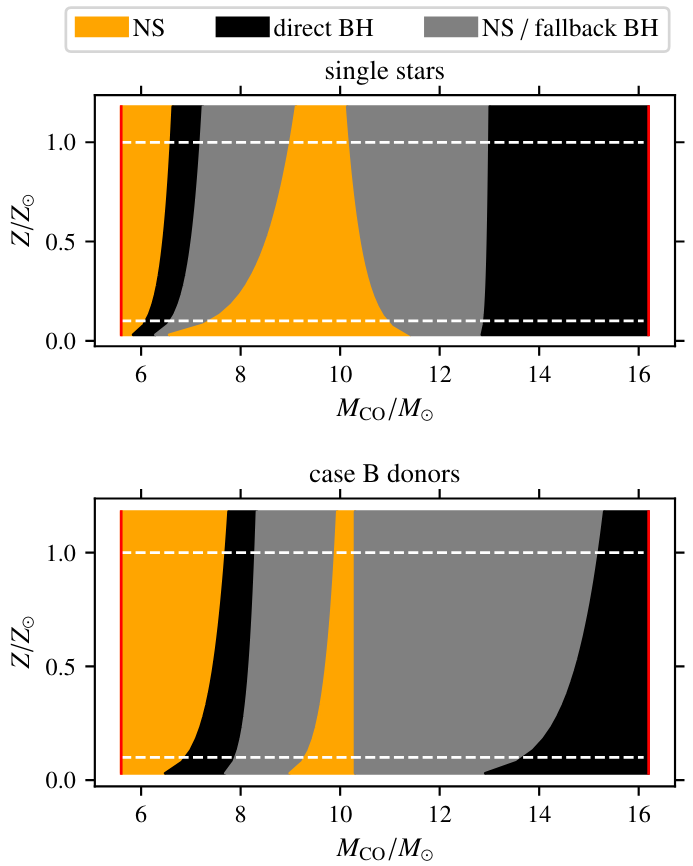
Fig. 1: The final fate landscape of massive stars undergoing iron core-collapse, as predicted by the SN recipe introduced in this work. The compact remnant left behind is color-coded (NS = neutron star, BH = black hole) in a diagram spanned by the carbon-oxygen core mass, , and the metallicity, . We find that the BH formation bands in of massive binary-stripped stars, which lose their hydrogen-rich envelope (here: "Case B"), are systematically shifted toward higher masses compared to single-stars. This makes BH formation from stripped stars a much rarer process than assumed in many previous works on statistical core-collapse SN modeling.

The SN recipe is available in several stellar binary population synthesis codes:


In recent work, we have used the new statistical SN model to predict cosmic binary BH mergers and to compare predictions with available gravitational wave data of observed merger events (most recent GWTC-5 data release). We find that the bimodal BH formation pattern predicted by our model imprints a trimodal peak-trough structure onto the distribution of chirp masses of binary BH (BBH) mergers over the low-mass range dominated by the isolated binary evolution BBH progenitor channel (below 30 solar masses), and see evidence for this feature in the observational data (see Fig. 2).
doi:10.48550/arXiv.2510.07573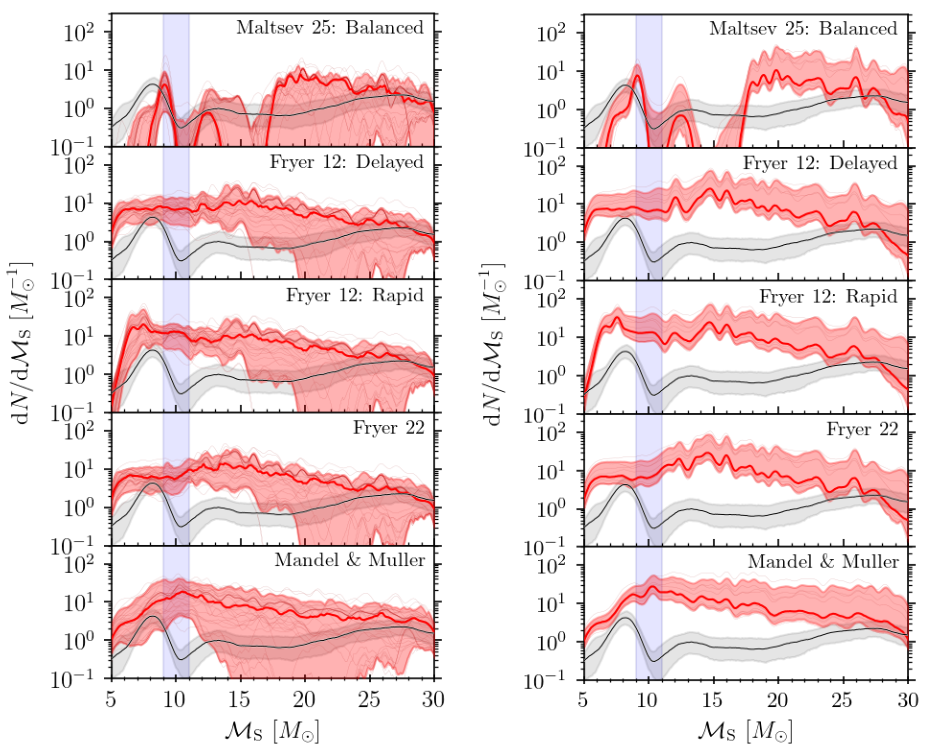
Fig. 2: Comparison of binary population synthesis predictions of the distribution of BBH merger chirp masses (in red) and their gravitational wave observations (in grey) after the latest GWTC-5 data release. The grey-shaded bands show observational uncertainties while the red bands show variations in the adopted binary evolution physics model (left panels) and the cosmic star formation history model (right panels). The only difference between the panels from top to bottom is the choice of the SN model (Maltsev 25, Fryer 12, ...) in an otherwise identical population synthesis setup. Our SN model robustly predicts a dip at around 10 solar masses that is confirmed by observations. Competing SN models overpredict the abundance of BBH mergers.
- Supernova explosion energies and compact remnant masses
In-progress work. Details to follow.
- Black hole formation and fundamental laws of physics
When a star fails to explode in a SN, the proto-NS that is formed in the innermost central region of the star accretes infalling mass until it loses stability and collapses. In a general-relativistic treatment of its gravitational collapse, matter contracts until it disappears behind the event horizon, the Second Law of Thermodynamics is violated, and one or even multiple gravitational singularities (geodesic incompleteness, infinite curvature, ...) form: we reach the frontiers of reliable prediction-making using established laws of physics. I addressed the following two questions:- Does the prediction of singularity formation in stellar gravitational collapse indicate the breakdown of General Relativity theory?
doi:10.1142/9789811269776_0298 - Do classical-limit Schwarzschild black holes transcend the laws of thermodynamics?
doi:10.1134/S1063772921100218
- Does the prediction of singularity formation in stellar gravitational collapse indicate the breakdown of General Relativity theory?
CORE-COLLAPSE SUPERNOVAE IN THE LOCAL MILKY WAY:
- Core-collapse supernova progenitor candidate stars within 2 kpc from Earth
Using photometry data from Gaia DR3, we conduct a census of OB-type stars in the local Milky Way to identify and characterize a population of 105,971 massive star systems within 2 kpc from Earth. Our census of OB-type stars, the most complete that has been conducted so far, unveils a complex view of the young stellar populations across the thin disk, with prominent large-scale features such as the Cepheus Spur, the Giant Oval Cavity, and a segment of the Sagittarius-Carina spiral arm all visible. Their inhomogeneous spatial distribution implies that massive star formation has taken place clustered across a few highly concentrated regions. We identify over 4,200 core-collapse SN progenitor candidate stars within 2 kpc, but predict none of those within the innermost 100 pc to explode within the next 1 Myr - an event that could be harmful to Earth's biosphere. Finally, we identify more BH progenitors to collapse within the next 1 Myr than SNe to explode, despite the former's much scarcer number - which could be indicative of a recent massive star formation burst having taken place in the local Milky Way.
doi:10.48550/arXiv.2607.07068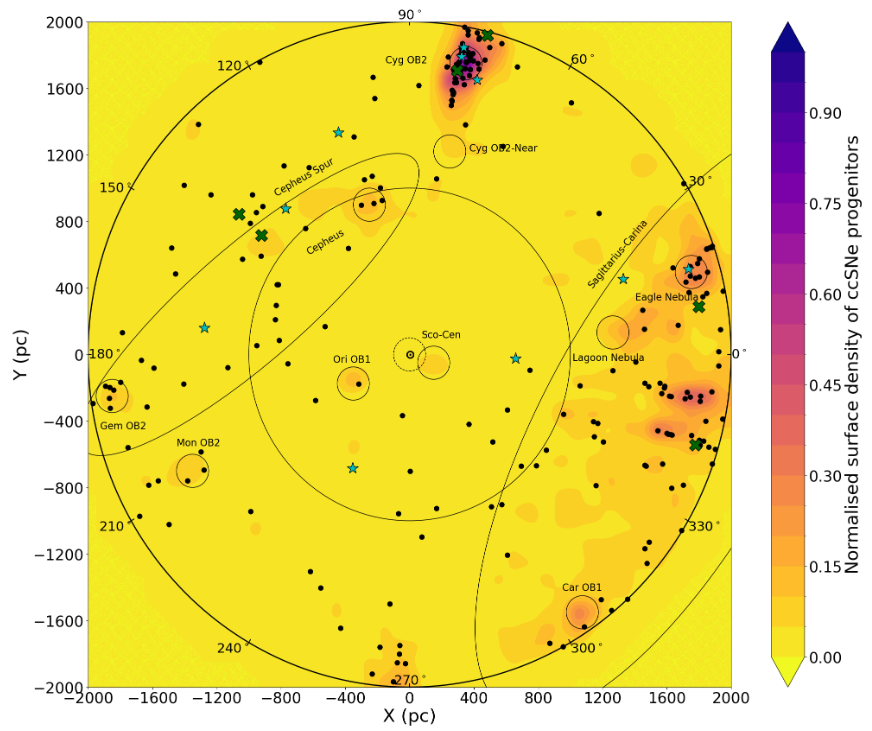
Fig. 3: A 2D map of OB-type star core-collapse supernova (ccSN) candidates we identify within 2 kpc from the Sun (center). The density distribution of those which we predicted to explode is color-marked while the much scarcer black hole progenitor candidate stars are shown as black points. The 10 stars which we predict to explode within the next 1 Myr are plotted as "star"-symbols while the 6 stars we predict to collapse to black holes within the next 500,000 years as crosses. The innermost circle around the Sun indicates the 100 pc radius, which is crossed by the Scorpius-Centaurus OB star association. The electromagnetic transient accompanying a ccSN explosion going off at this radius would become observable on Earth only after a delay time of 326 years.
- Supernova explosion and black hole formation rates
In-progress work. Details to follow.
- The Initial Mass Function of massive stars
Core-collapse supernova explosions in the local Milky Way are rare events primarily for the reason that the number of massive stars above the zero-age-main-sequence (ZAMS) mass threshold for ignition of core-neon burning and evolution through the advanced burning phases is scarce. Their abundance is determined during star formation by the stellar Initial Mass Function (IMF). The canonical IMF models of Salpeter (1955), Kroupa et al. (2001) and Chabrier (2003) predict that the high-mass tail ( > 1 solar mass) of the IMF is characterized by a single slope parameter, α, which remains stationary across the entire high-mass range. The high-mass IMF of local-field stars is little constrained observationally, and its improved understanding will allow us to refine estimates of supernova explosion rates, chemical enrichment and stellar feedback efficiencies, which are important for many astrophysical studies.
When comparing observations of local-field stars to stellar evolution models to infer their , interpolation of model catalogs for the iterative optimization-based parameter estimation is costly and therefore cannot be used to process large sample sizes.
To remedy this, we constuct an efficient deep-learning based surrogate model of stellar evolution, trained on evolutionary tracks pre-computed with the detailed stellar evolution code MESA while generalizing predictions over a continuous parameter space: it traces stellar evolution from the zero-age-main-sequence up to the end of core-helium burning while covering a mass range from red dwarves to 300 solar-mass stars. Its main advantage over classical interpolation of stellar model catalogs is the speed-up, as it casts millions of predictions within tens of seconds on a 4-core CPU, while keeping the predictive errors orders of magnitude below typical observational uncertainties. doi:10.1051/0004-6361/202347118
Fig. 4: Comparison of theoretical isochrones (computed using the stellar evolution code MESA) with the point predictions (casted by the ML-based surrogate model; scatter-plotted in black). Each color-coded isochrone shows the position of stars of the same age in the Hertzsprung-Russell diagram (spanned by the effective temperature Teff and bolometric luminosity ).

In ongoing work, we use this stellar evolution surrogate model to estimate α of the high-mass tail of the IMF of massive stars within 1 kpc.
GRAVITATIONAL WAVE ASTRONOMY OF HYPERMASSIVE NEUTRON STARS:
- Towards detection of gravitational waves from neutron star merger remnants
The merger of two NSs results either in prompt collapse to a BH or in a quasi-stable hypermassive neutron star (HMNS). The HMNS is supported by differential rotation, thermal effects and repulsive nuclear forces, and continues to emit gravitational waves (GWs) until it either stabilizes or undergoes a delayed collapse to a BH. One of the methods for ground-based detection of GWs emitted from cosmic HMNSs is the matched-filtering technique. It requires efficient GW template models that predict gravitational waveforms in the time- or frequency-domain as a function of astrophysical source parameters. The templates are scanned through the interferometry data in order to identify GW signals in a noisy background. In this work, we constructed a template model for the GW emission from HMNSs remaining quasi-stable for at least 17 ms after the merger, as a function of astrophysical source parameters, using numerical relativity simulations and supervised learning techniques. The template model is fast, accurate and noise-robust enough to in future be used for signal searches in the interferometry data of the Advanced LIGO detector network at design sensitivity as well as of next-generation detectors. Under Advanced LIGO conditions, we confirmed the earlier prediction that the main GW properties (in particular, the dominant and subdominant peak oscillation frequencies) can be reliably reconstructed up to a source luminosity distance of approximately 12 Mpc, and further found that signal detection is achievable even in the case that the Equation-of-State (EoS) model adopted in the search template only crudely replicates the actual EoS at source.
doi:10.1103/PhysRevD.111.023002
Fig. 5: GW emission from a NS merger remnant in time-domain. The output of a numerical relativity simulation is shown in black. It is part of the test data set, which the supervised learning model has not seen during the training. The prediction of the template model is shown in orange.
- The Equation-of-State dependence of the maximal mass of a non-rotating stable neutron star
In-progress work. Details to follow.
CV
-
EMPLOYMENT:
- Postdoc, Max-Planck-Institute for Astronomy (Germany), since 2026
- PhD researcher, Heidelberg Institute for Theoretical Studies (Germany), 2020 - 2024
- Data science and machine learning internships in Tokyo (Japan) and in Brussels (Belgium), 2019 - 2020
- Applied research internships in New-Delhi (India) and in Leverkusen (Germany), 2015 - 2016
-
DEGREES:
- PhD in Physics, Heidelberg University (Germany), 2020 - 2024
- Master of Studies in Philosophy of Physics, University of Oxford (UK), 2018 - 2019
- Master of Science in Physics, University of Münster (Germany), 2016 - 2018
- Bachelor of Science in Physics, University of Münster, 2011 - 2015
- Bachelor of Arts in Physics and Philosophy, University of Münster, 2011 - 2015
-
AWARDS and FELLOWSHIPS:
- Fellow of the International Max Planck Research School for Astronomy and Cosmic Physics,
Heidelberg University, 2020 - 2024 - Graduate scholarship, German Academic Exchange Service (DAAD), 2018 - 2019
- Trainee, European Space Agency, 2017 - 2018
funded 4-months research stay at the European Space and Astronomy Center (ESAC), Villanueva de la Cañada (Spain) - Talent support scholarship, Konrad Adenauer Foundation, 2013 - 2018
- Emerald award, Boston Consulting Group, 2015
- ERASMUS program undergraduate fellowship, Paris (France), 01/2014 - 07/2014
3rd year physics courses at ENS Cachan (today: ENS Paris-Saclay)
3rd year philosophy courses at Université Paris I Panthéon-Sorbonne - Visiting student fellowship, St. Catherine's college, University of Oxford, 10/2013 - 12/2013
-
TEACHING:
- Tutor in Stellar Astrophysics (masters class in Physics), Heidelberg University, summer term 2023,
- Tutor in Analytical Mechanics and Thermodynamics (bachelor class in Physics), Heidelberg University, summer term 2022
- Lecturer on selected topics in Computer Vision and Structure Formation, cultural forum "Alte Post", summer term 2020
-
ACADEMIC SERVICE:
- Journal referee for The Astrophysical Journal (ApJ), APJ Letters, Astronomy & Computing and Royal Astronomical Society Techniques & Instruments (RASTI)
- Co-supervision of Master student Vijayalakshmi V. Nair (Heidelberg University), Physics of Stellar Objects group, Heidelberg Institute for Theoretical Studies, 2024-2025 (received top mark for her thesis)
- Mentoring of war refugee high-school student from Ukraine, 07/2023 - 08/2025 (got admitted to study Physics at Heidelberg University,)
- Organization of parallel session on Machine Learning for Stellar Astrophysics, XVII Winter Workshop on Stellar Astrophysics, Heidelberg Institute for Theoretical Studies, 18-19/12/2023
- Co-organization of workshop on Machine Learning and Bayesian methods to fit massive star atmosphere models to observations, CZS summer school on Scientific Machine Learning in Astrophysics, Heidelberg University, 14-18/08/2023
-
OUTREACH:
- Organization of half-day workshop "Astrophysics in Heidelberg" for former scholars of the Konrad Adenauer Foundation, Heidelberg Institute for Theoretical Studies, 19/05/2023.
Contribution with two public talks (in german):- Introduction to stellar evolution, and
- Threats of Earth habitability from cosmic space versus from anthropogenic climate change
- Organization and chairing of Artificial Creativity discussion round, Heidelberg Institute for Theoretical Studies, 19/07/2021
- Public talks:
- Introduction to astronomy: cosmic distance scales,
Studierendenrat, Heidelberg University, 15/04/2023 - The vacuum in classical vs. in quantum field theory,
Ruskin School of Art, University of Oxford, 22/01/2019
- Introduction to astronomy: cosmic distance scales,
- Guide at hands-on stations and poster sessions:
- Universe on Tour – Lights out! Stars on! roadshow,
Federal Ministry of Education and Research (BMBF), Heidelberg, 21/07/2023 - Digital Worlds Explore Science festival 2022,
Klaus Tschira Foundation, Mannheim (Germany), 25/06/2022 - Structure and Symmetry Highlights of Physics festival 2017, BMBF, Münster, 19-23/09/2017
- Universe on Tour – Lights out! Stars on! roadshow,
- Interdisciplinary art work development with artists on themes related to climate change and/or structure formation in physics, with council funding and gallery hall exhibitions:
- WissenschafftKunst, cultural forum "Alte Post", Neuss, 2020 - 2021. Press releases: Rheinische Post and Stadt Kurier
- Oxford Society for Art and Ecology, Ruskin School of Art, Oxford, 2018 - 2019. More information in this blog post.
Talks
INVITED TALKS:- Cosmic explosions and black hole formation near Earth during its history, MPIA Galaxy Coffee, Max-Planck-Institute for Astronomy (Germany), 18/06/2026
- The final fate landscape of massive single- and binary-stripped stars, Istanbul University Observatory, Astronomy and Space Sciences Department, Istanbul University (Turkey), 14/05/2026 (online)
- Explodability and explosion energies of neutrino-driven supernovae, "Theoretical Astrophysics " group, IKP Theory Center, TU Darmstadt (Germany), 14/04/2026
- Stellar progenitor dependence of neutrino-driven supernova explosion energies, "Stellar atmospheres and mass loss " group, Astronomisches Rechen-Institut, Heidelberg University (Germany), 18/02/2026
- The explosion condition for neutrino-driven supernovae: Ertl+(2016) vs. Maltsev+(2025), "Theoretical astrophysics ", University of Florida (USA), 10/12/2025 (online)
- What is the minimal black hole mass that can be produced by massive single-star evolution?, Binary systems group, Max-Planck-Institute for Astronomy, Heidelberg, 03/12/2025
- Black hole formation from failed core-collapse supernovae: theory and observations, STRAND seminar, University of California, San Diego (USA), 23/10/2025 (online)
- Explodability criteria for the neutrino-driven supernova mechanism, SESTAS seminar, Max Planck Institute for Astrophysics, Garching (Germany), 13/11/2024
- Progenitor evolution, formation and collapse of neutron stars, Astro AI Lab, Interdisciplinary Center for Scientific Computing, Heidelberg University, 09/07/2024
- Which massive stars explode in neutrino-driven supernovae, and which don't?, Gravitational Wave Astrophysics group, Institute for Theoretical Astrophysics, Heidelberg University, 03/05/2024
- Machine-Learning methods for emulating stellar evolution models, Astrophysics, School of Physics and Mathematics, University of Surrey (UK), 22/02/2024 (online)
- Surrogate modeling applications in stellar astrophysics, Astrophysics research seminar, Los Alamos National Laboratory (USA), 28/09/2023 (online)
- Supervised learning for construction of matched-filtering templates of gravitational waves from the binary neutron star post-merger phase, Nuclear Astrophysics and Structure seminar, GSI Helmholtz Centre for Heavy Ion Research, Darmstadt (Germany), 12/05/2023
- Bayesian parameter estimation of Monte-Carlo modelled astrophysical red noise, European Space and Astronomy Center, European Space Agency (ESA), Villanueva de la Cañada (Spain), 06/04/2018
- Characterization of power-law noise, Self Organization and Complexity group, University of Münster, 05/02/2018
CONTRIBUTED TALKS (selection):
- Explosions of supernova progenitors with very massive carbon-oxygen cores are supported by the recent GWTC-4 gravitational wave data release, European Astronomical Society Meeting 2026, Lausanne (Switzerland), 29/06/2026
- What is the minimal black hole mass produced by massive single-stars terminating evolution as failed supernovae?”, 19th Stellar Astrophysics winter workshop, Heidelberg Institute for Theoretical Studies, 17/12/2025
- Black hole formation from failed core-collapse supernovae: theory and observations, 27th Relativistic Astrophysics Group (RAG) meeting, Opava (Czech Republic), 11/11/2025 (online)
- Explodability criteria for the neutrino-driven supernova mechanism, European Astronomical Society Meeting 2025, Cork (Ireland), 23/06/2025
- A more optimistic supernova explosion model for rapid binary population synthesis, European Astronomical Society Meeting 2024, Padova (Italy), 01/07/2024
- What is the ultimate fate of matter in stellar gravitational collapse?, Foundational challenges in cosmological studies of black holes workshop, University of Bonn, Bonn (Germany), 14/05/2024
- Stellar evolution forecasting with a timescale-adapted evolutionary coordinate and machine learning, Spring Meeting 2024 of the German Physical Society (DPG), Berlin (Germany), 08/03/2024
- Prediction of stellar evolution tracks, gravitational waves and core-collapse supernova outcomes with machine learning, 18th Australian National Institute for Theoretical Astrophysics workshop, Monash University (Australia), 07/02/2024
- Convective core overshooting effects on compact remnant mass and Type II explosion energy landscapes from massive single star evolution, Transients Down Under conference, Swinburne Institute of Technology (Australia), 29/01/2024
- Do classical-limit Schwarzschild black holes transcend the laws of thermodynamics?, Golden Wedding of Black Holes and Thermodynamics conference, 05/12/2023 (online)
- Efficient stellar evolution and final fate forecasting over continuous parameter spaces, 17th Stellar Astrophysics winter workshop, Heidelberg Institute for Theoretical Studies, 13/12/2022
- Deep learning emulation of the MESA/MIST stellar evolution models, VLT-Flames massive star conference, Heidelberg Institute for Theoretical Studies, 22/06/2022
- The Penrose 1965 singularity theorem in historical context of the black hole paradigm, 16th Marcel Grossmann Meeting, International Center for Relativistic Astrophysics, Rome (Italy), 8/07/2021 (online)
- Thermodynamics of classical Schwarzschild black holes, International summer school Black holes and the information loss paradox, University of Urbino, Urbino (Italy), 11/06/2021 (online)
- On continued gravitational contraction (Oppenheimer & Snyder 1939) International Max Planck Research School in Astronomy and Cosmic Physics research seminar, Heidelberg University, 21/01/2021 (online)
- On the foundations of black hole thermodynamics, 4th International Zel'dovich Meeting, International Center for Relativistic Astrophysics, Minsk (Belarus), 07/09/2020 (online)
- On computational theories of mind, The Ockham Society seminar, University of Oxford, 06/06/2019
- Black Hole 'singularity': breakdown of general relativity theory?, Spring Meeting 2019 of the German Physical Society (DPG), Munich (Germany), 18/03/2019
- Vacuum fluctuations in quantum field theory, and nothingness, The Ockham Society seminar, University of Oxford, 08/02/2019
- Interior Schwarzschild solution, stars and astrophysical high-energy emission, international summer school Understanding Relativity Theory: Special and General, University of Tübingen (Germany), 02/08/2017
Computer Art


